Marriage in India is not merely a personal relationship; it is also a legal bond governed by statutes, precedents, and constitutional guarantees. When a marriage breaks down, the law provides several routes for a spouse to seek relief, and judicial separation is one of the most significant among them. Over the past few decades, Indian family courts have increasingly recognised the need to protect women’s rights within matrimonial disputes, whether the case proceeds through contested litigation, judicial separation, or mutual divorce. This article examines how Indian family courts approach these matters, why judicial separation continues to matter even as mutual divorce becomes more common, and what women need to understand about their legal standing during marital breakdown. Drawing on practical experience shared by legal practitioners such as Familylawchamber, this piece aims to give readers a grounded, accurate, and useful understanding of the subject.
Understanding Judicial Separation in the Indian Legal Context
Judicial separation is a legal remedy under which a court permits a couple to live apart without formally dissolving the marriage. It is provided for under Section 10 of the Hindu Marriage Act, 1955, and similar provisions exist under other personal laws applicable to different religious communities in India. Unlike divorce, judicial separation does not end the marital status of the parties; it merely suspends certain marital obligations, such as cohabitation, while keeping the legal relationship intact.
Many women choose judicial separation as a first step before deciding whether to pursue a full and final dissolution of marriage. It offers a cooling-off period, allowing both parties to reflect on reconciliation without the immediate finality of divorce. For women who are financially dependent on their spouse, or who are still evaluating the long-term implications of ending a marriage, judicial separation can serve as a protective middle ground. It allows continued access to certain matrimonial rights, including maintenance, while creating legal distance from an abusive or unworkable relationship.
It is worth noting that judicial separation can, after a period of one year without resumption of cohabitation, become a ground for converting the case into a full divorce petition, including, in appropriate circumstances, a mutual divorce, if both parties later agree to part ways permanently. This flexibility is one reason judicial separation remains relevant even as more couples opt directly for mutual divorce proceedings.
The Constitutional and Statutory Foundation of Women’s Rights in Matrimonial Law
India’s Constitution guarantees equality before the law under Article 14, and prohibits discrimination on the grounds of sex under Article 15. These constitutional principles have shaped the interpretation of family law statutes over the years, pushing Indian courts toward more equitable outcomes for women in matrimonial disputes. The judiciary has, through a long line of judgments, read protective intent into laws governing maintenance, custody, streedhan, and domestic violence, recognising that women often enter matrimonial litigation from a position of economic and social disadvantage.
Several key statutes reinforce these protections. The Hindu Marriage Act, 1955, provides grounds for judicial separation and divorce, including provisions specifically designed to protect women, such as the right to seek dissolution on grounds of cruelty or desertion. The Protection of Women from Domestic Violence Act, 2005, gives women the right to reside in the shared household and seek protection orders, monetary relief, and custody orders. The Hindu Adoption and Maintenance Act, 1956, along with Section 125 of the Code of Criminal Procedure (now largely mirrored under the Bharatiya Nagarik Suraksha Sanhita), ensures that women and children are not left without financial support during or after matrimonial proceedings.
Family courts, established under the Family Courts Act, 1984, were specifically created to handle matrimonial and family disputes with a less adversarial, more conciliatory approach. These courts are tasked with promoting settlement wherever possible, which is one reason mutual divorce has become such an important part of Indian family law practice. Legal teams like Familylawchamber often emphasise that family courts are structured to prioritise amicable resolution, and this structural design benefits women who may otherwise struggle with prolonged, expensive, and emotionally draining contested litigation.
Why Mutual Divorce Has Become a Preferred Route for Many Women
Mutual divorce, governed primarily under Section 13B of the Hindu Marriage Act, 1955, allows both spouses to jointly petition for dissolution of marriage when they have been living separately for one year or more and mutually agree that the marriage has irretrievably broken down. For many women, mutual divorce represents a faster, less confrontational, and more predictable path out of a marriage that is no longer sustainable.
One of the biggest advantages of mutual divorce is the reduction in emotional and financial strain. Contested divorce cases in India can take years to resolve, often involving repeated court appearances, cross-examinations, and prolonged uncertainty. Mutual divorce, by contrast, typically involves two motions filed before the family court, with a mandatory cooling-off period that can, in appropriate cases, be waived by the court. This means that women who choose mutual divorce can often resolve custody, maintenance, and property matters through negotiated settlement rather than adversarial litigation.
Another important reason mutual divorce is increasingly preferred is that it allows women greater control over the terms of settlement. In a mutual divorce, both parties negotiate issues such as alimony, child custody, visitation rights, and division of assets before approaching the court. This negotiated approach often results in outcomes that are more tailored to the specific needs of the woman and her children, compared to a court-imposed decision after prolonged litigation. Practitioners at Familylawchamber frequently advise clients that a well-negotiated mutual divorce settlement can protect a woman’s financial interests more effectively than an uncertain contested trial, particularly when there is a genuine willingness on both sides to part amicably.
That said, mutual divorce is not without its complications. Women must be cautious about signing settlement agreements without a clear understanding of their legal entitlements. It is not uncommon for women to unknowingly waive their right to future maintenance or fail to adequately address child custody arrangements in the rush to finalise a mutual divorce. This is why legal guidance is essential even in seemingly amicable mutual divorce cases; the assistance of an experienced family law practitioner ensures that the terms of a mutual divorce genuinely protect the woman’s rights rather than merely expediting the process.
Judicial Separation Versus Mutual Divorce: A Comparative Understanding
Although judicial separation and mutual divorce serve different purposes, they are often discussed together because both provide legal alternatives to prolonged contested litigation. Judicial separation is generally sought when at least one party is not yet ready for permanent dissolution, whether due to religious beliefs, social pressures, financial dependency, or hope for reconciliation. Mutual divorce, on the other hand, is chosen when both spouses have already reached a settled decision that the marriage cannot continue.
A few key distinctions are worth highlighting:
- Judicial separation preserves the legal status of marriage, meaning neither party can remarry, while mutual divorce fully dissolves the marriage, allowing both parties to remarry once the decree is granted.
- Judicial separation can be sought unilaterally by one spouse on statutory grounds such as cruelty or desertion, whereas mutual divorce requires the consent of both spouses.
- Maintenance and support obligations may continue differently under judicial separation compared to a finalised mutual divorce settlement, where financial terms are typically settled once and recorded in the court order.
- Judicial separation offers a legal safety net for women who are not yet financially or emotionally prepared for full separation, while mutual divorce offers finality and closure for those ready to move forward.
For many women navigating a difficult marriage, understanding this distinction is critical. Some women approach judicial separation as an interim measure, only to later convert the proceedings into mutual divorce once both parties are certain about ending the marriage permanently. Family law professionals, including those at Familylawchamber, often guide clients through this transition, helping them evaluate whether mutual divorce is the right next step or whether continued judicial separation better serves their immediate needs.
The Role of Family Courts in Protecting Women During Matrimonial Disputes
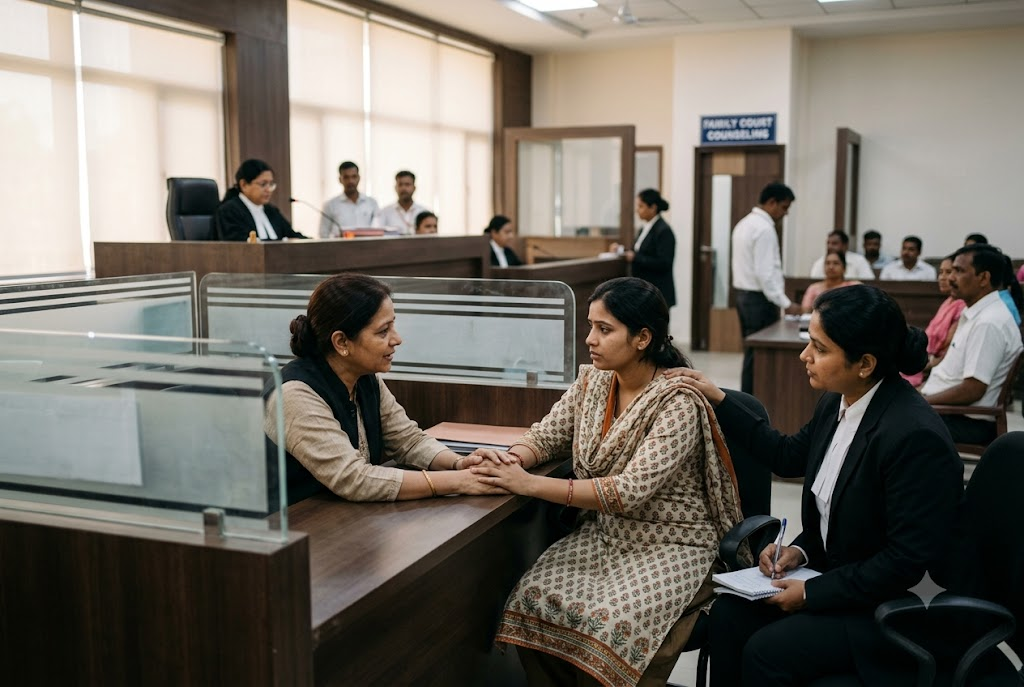
Family courts in India operate under a mandate that is different from ordinary civil courts. Section 9 of the Family Courts Act, 1984, requires these courts to make efforts toward settlement and reconciliation before proceeding to a full trial. This conciliatory framework has significant implications for women, since it creates space for negotiation rather than forcing immediate adversarial confrontation.
In practice, this means that when a woman approaches a family court, whether for judicial separation, maintenance, custody, or mutual divorce, the court will typically first explore whether reconciliation or amicable settlement is possible. Counsellors attached to family courts often play a mediating role, helping both parties understand their rights and obligations. For women who have faced domestic abuse or coercive control, family courts are increasingly sensitive to the power imbalance that can exist in settlement negotiations, and judges are expected to ensure that any agreement, including a mutual divorce settlement, is entered into freely and without undue pressure.
Indian courts have, over the years, delivered several judgments reinforcing the principle that mutual divorce settlements must genuinely reflect the free will of both parties. If a woman later demonstrates that her consent to a mutual divorce was obtained under duress, courts retain the power to reconsider such agreements, particularly where maintenance or custody arrangements are grossly unfair. This judicial oversight is an important safeguard, ensuring that mutual divorce does not become a tool for financially or socially dominant spouses to pressure women into inequitable settlements.
Family courts have also increasingly waived the statutory six-month cooling-off period in mutual divorce cases where reconciliation is clearly impossible and prolonging the process would cause unnecessary hardship, particularly to women who need to move forward with their lives, secure employment, or plan for their children’s future. This judicial flexibility reflects a broader recognition that rigid procedural timelines should not come at the cost of a woman’s practical wellbeing.
Maintenance, Alimony, and Financial Security in Mutual Divorce and Judicial Separation
Financial security remains one of the most pressing concerns for women going through matrimonial breakdown. Indian law provides multiple avenues for women to claim maintenance, whether interim or permanent, during judicial separation, contested divorce, or mutual divorce proceedings. Section 24 of the Hindu Marriage Act allows for interim maintenance during the pendency of proceedings, while Section 25 allows for permanent alimony to be granted at the time of the final decree.
In mutual divorce cases, the amount and structure of alimony are typically negotiated between the parties and then recorded in the settlement agreement submitted to the court. This negotiated aspect of mutual divorce can be advantageous for women, since it allows for creative solutions, such as lump-sum settlements, transfer of property, or structured periodic payments, tailored to the specific financial circumstances of the family. However, this same flexibility can also be a risk if the woman does not have adequate legal representation during negotiations. A poorly negotiated mutual divorce settlement can leave a woman without sufficient financial support, particularly if she has been out of the workforce for an extended period or has primary responsibility for childcare.
This is an area where firms such as Familylawchamber play a meaningful role, helping women evaluate whether a proposed mutual divorce settlement genuinely reflects their financial needs, future earning capacity, and the standard of living they maintained during the marriage. Courts have repeatedly emphasised that alimony should not be treated as a mere formality; it should reflect a realistic assessment of the woman’s post-divorce financial position, especially when children are involved.
Child Custody Considerations in Judicial Separation and Mutual Divorce
Child custody is often the most emotionally charged aspect of any matrimonial dispute, and it carries particular weight in both judicial separation and mutual divorce cases. Indian courts apply the principle of the best interests of the child as the paramount consideration when determining custody arrangements, regardless of whether the case proceeds through contested litigation or mutual divorce.
In judicial separation cases, custody arrangements may be temporary, reflecting the fact that the marriage has not yet been formally dissolved and reconciliation remains a possibility. In mutual divorce cases, custody terms are typically finalised as part of the overall settlement, covering physical custody, visitation rights, and financial responsibility for the child’s education and upbringing.
Mothers are often granted custody of young children, particularly in cases involving children below the age of five, reflecting a judicial presumption that young children benefit from maternal care, though this presumption is not absolute and courts examine the specific facts of each case. Fathers seeking custody must demonstrate that the arrangement serves the child’s welfare, and courts increasingly favour shared or joint custody arrangements where feasible, recognising the importance of both parents remaining involved in a child’s life after mutual divorce.
Women pursuing mutual divorce should approach custody negotiations carefully, ensuring that visitation schedules, decision-making authority regarding education and healthcare, and financial contributions from the other parent are clearly documented in the settlement agreement. Ambiguous or poorly drafted custody terms in a mutual divorce settlement can lead to future disputes, requiring the parties to return to court for clarification or enforcement.
Domestic Violence and Its Intersection with Judicial Separation
For many women, judicial separation or mutual divorce is not simply about incompatibility but about escaping an abusive relationship. The Protection of Women from Domestic Violence Act, 2005, provides a crucial legal framework that intersects closely with judicial separation proceedings. Women facing physical, emotional, financial, or sexual abuse can seek protection orders, residence orders, and monetary relief under this legislation, often alongside or prior to filing for judicial separation or mutual divorce.
Indian family courts have shown increasing sensitivity to the realities of domestic abuse, recognising that women in abusive marriages often face significant barriers to leaving, including financial dependency, fear of social stigma, and concerns about child custody. Judicial separation can provide an important interim measure for women who need legal distance from an abusive spouse without immediately committing to the finality of divorce, particularly if they are still assessing their safety, financial independence, or the wellbeing of their children.
When domestic violence is a factor, courts are generally cautious about pushing parties toward mutual divorce negotiations without first ensuring that the woman is not being coerced into an unfair settlement out of fear or desperation to exit the relationship quickly. Legal practitioners advising women in such situations, including those consulting Familylawchamber, often stress the importance of securing protective orders and financial stability before finalising a mutual divorce settlement, ensuring that the woman’s long-term safety and welfare are not compromised for the sake of a faster resolution.
Streedhan, Property Rights, and Economic Justice for Women
Beyond maintenance and custody, Indian women involved in matrimonial disputes often need to address the recovery of streedhan, which refers to property and gifts given to a woman before, during, or after her marriage, and which legally belongs to her alone. Courts have consistently held that streedhan remains the exclusive property of the woman and must be returned to her upon judicial separation or divorce, regardless of the outcome of other financial negotiations.
In mutual divorce cases, streedhan is often addressed as part of the broader settlement discussion, though it is important for women to understand that streedhan is legally distinct from alimony or maintenance and should not be conflated with it during negotiations. Women pursuing mutual divorce should ensure that any settlement agreement explicitly addresses the return of streedhan, jewellery, and other personal property, rather than allowing these issues to be absorbed vaguely into a general financial settlement.
Property rights more broadly also remain an important consideration. While Indian matrimonial law does not automatically grant a wife a share in her husband’s separate property upon divorce, courts have increasingly recognised the value of a woman’s non-financial contributions to the household and family when determining fair settlement terms in mutual divorce cases. This evolving judicial approach reflects a broader shift toward economic justice within family law, acknowledging that homemaking and childcare responsibilities carry real economic value that should be factored into divorce settlements.
Procedural Aspects of Mutual Divorce Every Woman Should Understand
Understanding the procedural steps involved in mutual divorce can help women approach the process with greater confidence and clarity. The process generally unfolds as follows:
- Both spouses must have been living separately for a period of at least one year before filing a joint petition for mutual divorce under Section 13B of the Hindu Marriage Act.
- The first motion involves both parties appearing before the family court to record their mutual consent to dissolve the marriage, along with the terms of settlement regarding maintenance, custody, and property.
- A statutory cooling-off period of six months typically follows, during which the parties may reconsider their decision, though courts can waive this period in appropriate circumstances where reconciliation is clearly not possible.
- The second motion requires both parties to reaffirm their consent before the court, after which the family court passes a decree of divorce, formally dissolving the marriage.
Throughout this process, it is essential for women to retain independent legal advice, even when the mutual divorce appears entirely amicable. Settlement terms agreed upon during mutual divorce proceedings are generally binding and difficult to modify later, making it critical to ensure that all financial and custodial arrangements are fair, complete, and clearly documented before the final decree is granted. Experienced family law practitioners, such as those at Familylawchamber, routinely assist women in reviewing settlement terms to confirm that their rights are fully protected before they sign any agreement or appear before the court for the second motion.
Common Challenges Women Face in Judicial Separation and Mutual Divorce Cases

Despite the legal protections available, women continue to face practical challenges when navigating judicial separation or mutual divorce. Financial dependency remains one of the most significant obstacles, particularly for women who have been homemakers throughout their marriage and lack independent income or assets. Social stigma also continues to affect women disproportionately, with divorced or separated women often facing judgment from extended family and community networks, even as attitudes gradually shift in urban areas.
Access to quality legal representation is another persistent challenge, particularly for women in smaller towns or from economically disadvantaged backgrounds. While mutual divorce is generally faster and less expensive than contested litigation, women still need competent legal guidance to ensure that settlement terms are fair and enforceable. Delays in court proceedings, inconsistent application of maintenance guidelines across different courts, and difficulties in enforcing custody or maintenance orders after a mutual divorce decree has been granted also remain ongoing concerns within the Indian judicial system.
Awareness of legal rights is equally important. Many women remain unaware of their entitlement to interim maintenance, protection under domestic violence legislation, or their right to negotiate favourable terms during mutual divorce proceedings. Increasing legal literacy among women, alongside continued judicial sensitivity to gender-based disadvantages in matrimonial disputes, remains essential to ensuring that the protections written into Indian family law translate into real, practical justice.
The Way Forward: Strengthening Women’s Rights Within Indian Family Courts
Indian family courts have made meaningful progress in recognising and protecting women’s rights during judicial separation and mutual divorce, but there remains room for further reform. Faster case disposal, standardised guidelines for maintenance calculations, greater access to legal aid, and continued training for judges and family court counsellors on issues of domestic violence and coercive control would all strengthen the system’s ability to deliver equitable outcomes for women.
Mutual divorce, in particular, holds significant promise as a mechanism for reducing the emotional and financial toll of marital breakdown, provided that women enter such settlements with full awareness of their rights and adequate legal support. As more couples choose mutual divorce over prolonged contested litigation, the responsibility falls on family courts, legal practitioners, and support organisations to ensure that this shift genuinely benefits women rather than simply expediting the dissolution of marriage at their expense.
Legal practices such as Familylawchamber continue to play an important role in this evolving landscape, helping women understand their options, whether that means pursuing judicial separation as an interim measure, negotiating a fair mutual divorce settlement, or seeking protection under domestic violence legislation. As Indian society continues to evolve, so too must the family court system, ensuring that judicial separation and mutual divorce remain genuine pathways to justice, dignity, and financial security for women across the country.
Conclusion
Judicial separation and mutual divorce represent two distinct but interconnected legal pathways available to women navigating the breakdown of a marriage in India. While judicial separation offers a protective interim measure for those not yet ready for permanent dissolution, mutual divorce provides a faster, more collaborative route to finality for couples who have mutually decided to part ways. Throughout both processes, Indian family courts have increasingly prioritised the protection of women’s rights, whether through maintenance provisions, custody safeguards, or judicial oversight of settlement fairness. Women considering either path should seek informed legal guidance to ensure that their rights, both financial and personal, are fully protected. With continued judicial sensitivity and the support of experienced family law practitioners like Familylawchamber, mutual divorce and judicial separation can both serve as meaningful tools for women seeking justice, independence, and a fresh start.